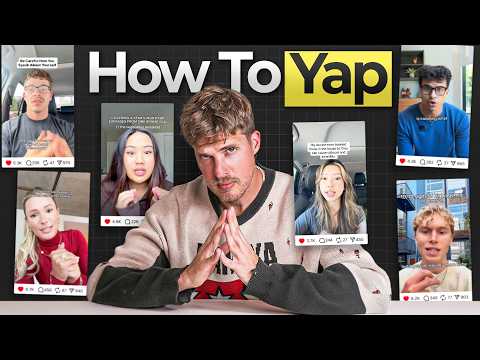
The case for yapping
Why bother talking on the internet at all:
- Short-form is the comms layer now. Instagram, TikTok, LinkedIn, X, even Netflix going vertical. The thing you share with your wife in the group chat is the thing you're shaped by. Same in business and Slack groups.
- It makes you a better communicator. Made him a better salesperson, marketer, articulator — and "more personable overall."
- It's an idea engine. "I am fascinated with putting out original concepts." Workshopping takes in conversations, telling people you make content unlocks better stress-tests, leads to a "more thoughtful life."
- The algorithm rewards conversation. "Conversation is what drives videos." Strong opinions generate replies.
- The market is still wide open. "A once-in-a-lifetime opportunity of getting free attention on the internet."
Oren started at 37. Was "quieter, more introverted… my mind always worked faster than what I would say." In the right scenario he could "spit out a lot of quality information really quickly to give people context" — but content made it consistent.
The 4 questions content forces you to answer
Oren spells this out as the internal monologue he runs on every piece. Use this on any pitch, email, or conversation, not just on camera:
- What message am I trying to get across?
- How do I get this person's attention about it?
- How do I dispel the limiting beliefs they have around what I'm saying?
- How do I present a story that gets them from their perspective to the finish line of whatever I'm explaining?
"And now I think of all the conversations like that." — that's the spillover. Sales calls, DMs, pitches, brand deals — all start running on this script.
The staircase he sells at the end
This is his closer for why you should do this — five rungs, low-stakes to high-stakes:
- Skillset — even if nothing else happens, you learn to communicate.
- Communication — start thinking about the world more sharply.
- Modern-world fluency — understand how attention/distribution works.
- Career trajectory — significantly change where you go in your career.
- Side income + economy participation — "a once-in-a-lifetime opportunity of getting free attention on the internet."
Even the lowest rung is worth it.
The 6 format variants
Pick one. Don't overthink it. The whole system is set up to make this easy.
| # | Format | What | Example |
|---|---|---|---|
| 1 | Standard yap | Phone on tripod. Sit. Talk. | Brandon (TikTok) — doesn't even use captions. Woman doing "best Caesar wrap in Orange County." |
| 2 | Walking yap | Phone in hand, in motion. Feels like FaceTime with a friend. | Christian — "yap king." |
| 3 | Car yap | Driver's seat. Candid. Don't even look at the camera that much. | Tom (@bonusfootage), Cut30 grad. |
| 4 | Chaotic graphic yap | Just slap clips over your video via the overlay function in Edits or CapCut. ~1 graphic per 2 seconds. | Cut30 grad — "this video ripped for her." |
| 5 | Framed graphic yap | Frame yourself with headroom so a vertical graphic always sits above. Mind head, caption, graphic placement. | Cut30 grad. |
| 6 | Full-screen 9:16 overlay | Talk while Canva 9:16 graphics fill the frame on top. ~1 every 2s. | Oren's own. |
Cut30's rules of thumb:
- One graphic every ~2 seconds
- Planning a 60s video → get 30 images. "Takes way less time than you think."
- All graphics must be vertical (so they overlay cleanly)
- His own casual yaps land at 2-3 minutes (Coachella content was his benchmark)
Beginner note: Oren explicitly does not recommend the standard sit-and-talk yap as your first format — "It's too many variables. So you have a good understanding of what content moves." Walking yap is "slightly more advanced." Translation: start with whichever feels easiest and just ship — you'll learn what content moves through reps.
Graphics aren't decoration — they're evidence. Oren's framing: "Graphic yaps help keep attention by just providing examples of what you do there." Each graphic should be illustrative of the point you're making. Not aesthetic filler.
The mantra: "You can get as advanced as you want. But it does not matter. The key to the yap is you just do it. The whole thing is set up to make you want it to be easy."
The 5 narrative frameworks
These cover ~90% of working short-form. Anything outside reads as generic.
1. Strong Take
Say something is the best or the worst. Then defend it.
Examples (Christian, the master):
- "Orlando is the best sports city in North America."
- "Champions is the best sports bar on the East Coast."
- "Blank pizza is the best in [wherever]."
Universal templates:
- "This is the absolute best concealer for [X skin type]."
- "This is the superior energy drink versus that one."
- "This is the best choice for your influencer marketing software."
Why it works: Forces conviction. Forces you to make something interesting. People respond positively or negatively. Conversation drives videos.
2. Strong Take → Education
The take is just a hook to set up a teach.
Oren's exact example (Coachella video):
- Hook: "There are way too many Coachella influencers. The brands can't possibly be getting value out of this."
- Pivot: "Well, let's actually break down content supply and demand…"
- Teach: It's not too many influencers — demand for content is so high it outperforms. He breaks down evergreen vs. current content.
The rule: Provide value on the back end. Don't be clickbaity. "It's about starting the conversation."
3. Small Epiphany
Relatable observations. "Notice how [X] always [Y]?"
Templates:
- "Do you notice how husbands always do this?"
- "Notice how East Coast people are always doing that?"
Prompt for yourself: What are the things you always see yourself doing, or unexpected, or funny, or shared experiences?
Why it works (the camaraderie loop): Viewers split into:
- "I've never noticed this"
- "Oh my god, that's so funny — I hadn't thought of that"
- "Oh yeah, I do that too"
All three reactions build kinship with you.
4. Humor
Saying something funny. A scenario that happened. Making fun of something.
Example: A yapper who roasts overrated places in LA.
5. Story Time
A narrative from your life.
Template: "I just got rear-ended at [intersection] and I can't believe that [Z] happened."
The aggregate rule: "Strong Takes, Small Epiphanies, and Story Time is like the foundation for 90% of the content you can make, yap."
What NOT to do (his explicit blacklist)
- ❌ "My top 3 favorite [whatever]"
- ❌ "3 ways on e-comm"
- ❌ Motivational speeches
- ❌ Generic listicles with no take
"These are all narrative arcs for strong opinions. If you're thinking outside that box and it's generic, it's not gonna work."
The Yap Map (daily ideation ritual)
The one habit that makes the system work. Whiteboard, paper, or notes app.
When: During your commute, or any time you'd be scrolling.
Mine 7 sources:
- Touchpoints of your day — what happened at work, what you ate, conversations, meetings, the little things.
- Questions that came up — "Why do people do influencer marketing at Coachella? Should we be doing that as an accounting brand?"
- Overheard conversations — "I'm at lunch and someone's talking about depreciating their G-Wagon through their business."
- Jokes / movies / shared TV — everyone watching the same show; do you have an opinion based on your background?
- Personal life / interpersonal — dating is gold. "Why is it so hard to find a tradwife in Minneapolis?"
- Media you ingest — tweets, Instagram, news. "I don't like this trend. This news thing is crazy."
- Shower / workout thoughts — when you're off the phone, the background ideas surface. Catch them.
Frequency target: 3–5 ideas/day. Oren has "hundreds and hundreds and hundreds now."
Permission slip on the source quality: "You'll be surprised how small it is." The lunch convo about depreciating a G-Wagon. The same TV show everyone's watching. Banal beats grand. Your edge is your angle on the small thing, not the size of the topic.
Then add the take: "Do I have a strong opinion? A story? A relatable thing I can break down?"
Workshop the take in real life before you film it. Tell people you make content — "They know I make content, we talk about this idea, they share their opinions." Conversations stop being chitchat and become free A/B testing for hooks.
"You'll be surprised — even if you put one down today and three down tomorrow — how big the list gets."
The 3 scripting frameworks
Pick one structure once you have idea + take. Oren is explicit: these are starter scaffolds, "a few [frameworks] and you can start experimenting with your own." Once you internalize them, derive your own.
A. Hook → Story → Point 1 → Point 2
- Hook: the take. "Kick Coffee is the best coffee shop in Newport Beach."
- Story: "I was getting a latte the other day with two realtor friends. They wanted to go to this shop, I wanted to go to this shop. X happened, Y happened…" (Use your own life OR someone else's: "When Steve Jobs was 19…")
- Point 1: "It's the best because of this."
- Point 2: "It's the best because of that."
The story is what keeps them retained between hook and reasoning.
B. The 8 Mile
Named after the rap battle. Pre-empt the comment section.
- Hook: your take.
- Steel-man the opposition: "Now, people might say X, Y, Z…" — explain everything they'd argue. Then knock it down.
- Make your point.
Why it works: Viewers are already thinking the objections. You explain them BEFORE they form, which keeps people retained. Same shape works for personal anecdotes too.
C. The 4 Things / 5 Things
Mini-listicle of takes inside one larger take.
Setup: "Here are 4 observations I made at Coachella as a brand strategist."
- Beat 1: "Nike is falling off — I didn't see any Nikes on feet."
- Beat 2: "Gap is doing a great job — lines were out the door."
- Beats 3–4: same shape.
Each beat is itself a strong take. Promise of "the next one" stacks retention.
Recording stack
Verbatim from the video. Nothing here is invented — what Oren actually said.
| Item | What he said |
|---|---|
| Camera | iPhone |
| Mic | "Rode Plug-in USB-C mic for the phone. You don't need anything more than that. You should get a mic to do it." |
| Backup mic | "You can also use the Apple EarPods. AirPods do not work." |
| Tripod | "TumTek from Amazon… expands out, legs on the bottom. Bluetooth remote, it was like 50 bucks." |
| Car mount | "One of those little dash cameras that connects to the MagSafe on your iPhone." |
| Mobile editor | CapCut or Edits — use the overlay function to drop graphics |
| Desktop editor (optional) | "An app called Recut that's like 20 bucks or something." (or use built-in editor silence-kill) |
| Graphics | Canva, 9:16 vertical so they overlay clean |
The Recut method (his core technique)
Most people record clean and stop when they get stuck. Oren records like this:
- Talk.
- When you need to think — stay quiet, hold eye contact with the camera.
- Take as long as you need.
- Look back at the camera, speak again.
- In post: kill all silences (Recut app, or built into CapCut/most editors).
"You might end up with a six or seven minute clip because you're taking a bunch of pauses, but it allows you to think and get your bearings before saying the next thing."
Alternative (simpler): record + talk slowly enough that you can keep going without pauses.
The "redo intro at end" rule
"Usually when you start and you begin your recording, it's the most important part of the video, but you're the most awkward, especially when you're new. But by the time you're done talking for three minutes, you're in a much better mood, you're in a much better flow."
Re-record the intro at the end and edit it onto the front.
Captions + title (always)
- Captions on every yap — "I highly recommend for almost everybody that you put the actual captions of what you're saying on it."
- Title card on graphic yaps — "add a title. These are really important to do."
- Final edit: directly in TikTok works, but he recommends CapCut or Edits.
- He has a separate cheat sheet for captions/titles in the HYPER newsletter.
Composition for framed yaps
Note head placement, caption placement, graphic placement. Frame yourself with headroom so the graphic always sits cleanly above.
Mindset
"You are there to light people up. You're there to get people excited, to make them laugh, to have them be thrilled. So be excited, be passionate, care, have fun with it. Because that really comes through in the phone."
"One of the advice I give a lot of my friends to try to make content — they just look like they're not having fun. And if that's the case, it's probably not gonna do very well. People are gonna feel that."
Strong-take energy = conviction. No conviction, no take.
Permission slips
The level-above rule: "No matter your age, your expertise — people wanna hear from people that are at their level or level right above them. Doesn't matter how experienced you are or not. It's about sharing that journey."
The age/weirdness rule: "There is nobody who is too old or too weird and needs to do this. It's just about getting through it."
He started at 37.
Examples he namechecks
| Creator | Used to demo | Notes |
|---|---|---|
| JT | Hook for the whole video — "I really think you should become an influencer" | The springboard |
| Christian ("yap king") | Walking yap + master of strong takes | Orlando / Champions / pizza takes |
| Brandon (TikTok) | Standard yap, no captions | Just talks to the iPhone |
| Unnamed female creator | Standard yap | "Best chicken Caesar wrap in Orange County" |
| Tom (@bonusfootage, Cut30 grad) | Car yap | Doesn't even look at the camera |
| Cut30 grad (female) | Chaotic graphic yap | "This video ripped for her" |
| Cut30 grad (male) | Framed graphic yap | Headroom for graphic above |
| The LA-critique yapper | Humor framework | Roasts overrated LA spots |
| Steve Jobs | Script template stand-in | "When Steve Jobs was 19…" |
Specific videos Oren himself talks about
These are examples of his own take-driven topics. Use as a template for your own.
- Coachella content — yapping at the festival about brand strategy in 2-3 minute videos
- Zip code video — "Your zip code over-indexes as a factor as to where you go in life."
- McMansion video — "The ideal home size for almost everybody is like 1700 square feet."
- Coachella influencer take — strong-take→education hook on supply/demand
- Influencer marketing for an accounting brand — yap-map source question
- Kick Coffee Newport Beach — script template
- Coachella 4-things — Nike falling off, Gap winning, etc.
Vernacular (use this exact terminology)
Oren explicitly says: "This is so important for vernacular. You wanna have the right terminology."
The locked-in words:
- Yap (the activity)
- Standard yap / walking yap / car yap
- Graphic yaps (chaotic / framed / full-screen overlay)
- Yap map (the daily idea log)
- Recut method
- The 8 Mile (framework B)
- Strong take
- Strong take into education
- Small epiphany
- Story time
- Yap king (Christian)
- Light people up (energy/mindset)
Sponsor + funnel
- Sponsor (paid): HubSpot — "10X Your LinkedIn Game Starter Pack" free PDF. Adam Biddlecombe's Growth Guide (zero → 100K on LinkedIn in under a year, led to HubSpot acquisition), Mindstream's one-page cheat sheet, LinkedIn profile playbook.
- LinkedIn pitch: "Extremely slept on. Doesn't matter about views — quality of views is so high because you're reaching actual professionals." Personal-brand framing: "Consistent perception of what you're known for across photo, headline, summary, content."
- HYPER newsletter — yapping cheat sheet promised that week.
- Cut30 cohort — 30 days of accountability with coaches + curriculum. Runs every ~6 weeks. Optional, not required. "I would recommend just go and get started with what I have here. If you wanna do this with 30 days of accountability, the next cut 30 starts early May." Cohort = if you want accountability, not gating.
- Community call — first few days of each month, live Q&A after training. People meet in chat.
- Brand partnerships — oren@delucamediagroup.com.
Algorithm + retention insights worth pinning
- Conversation drives videos. Strong opinions → replies → distribution.
- Hook value contract: can be punchy, but the back end must deliver. "It's about starting the conversation."
- Pace for retention: 1 graphic per 2 seconds, ~30 graphics per 60s.
- 8 Mile = preempting the comment section — say what they're already thinking.
- Audience proximity rule: people want to hear from someone at their level or one level above.
- The brand on LinkedIn: consistency across photo, headline, summary, and posts.
Source
- Audited video: The Art of Yapping (full guide to talking on video)
- Posted: 2026-04-26
- Length: 17:54
- Sponsor: HubSpot
- Audited by: Alex + Claude on 2026-04-28
- Local artifacts:
/tmp/yt-audit/yap.txt(618-line transcript),/tmp/yt-audit/yap-video.webm,/tmp/yt-audit/frames/(36 keyframes)